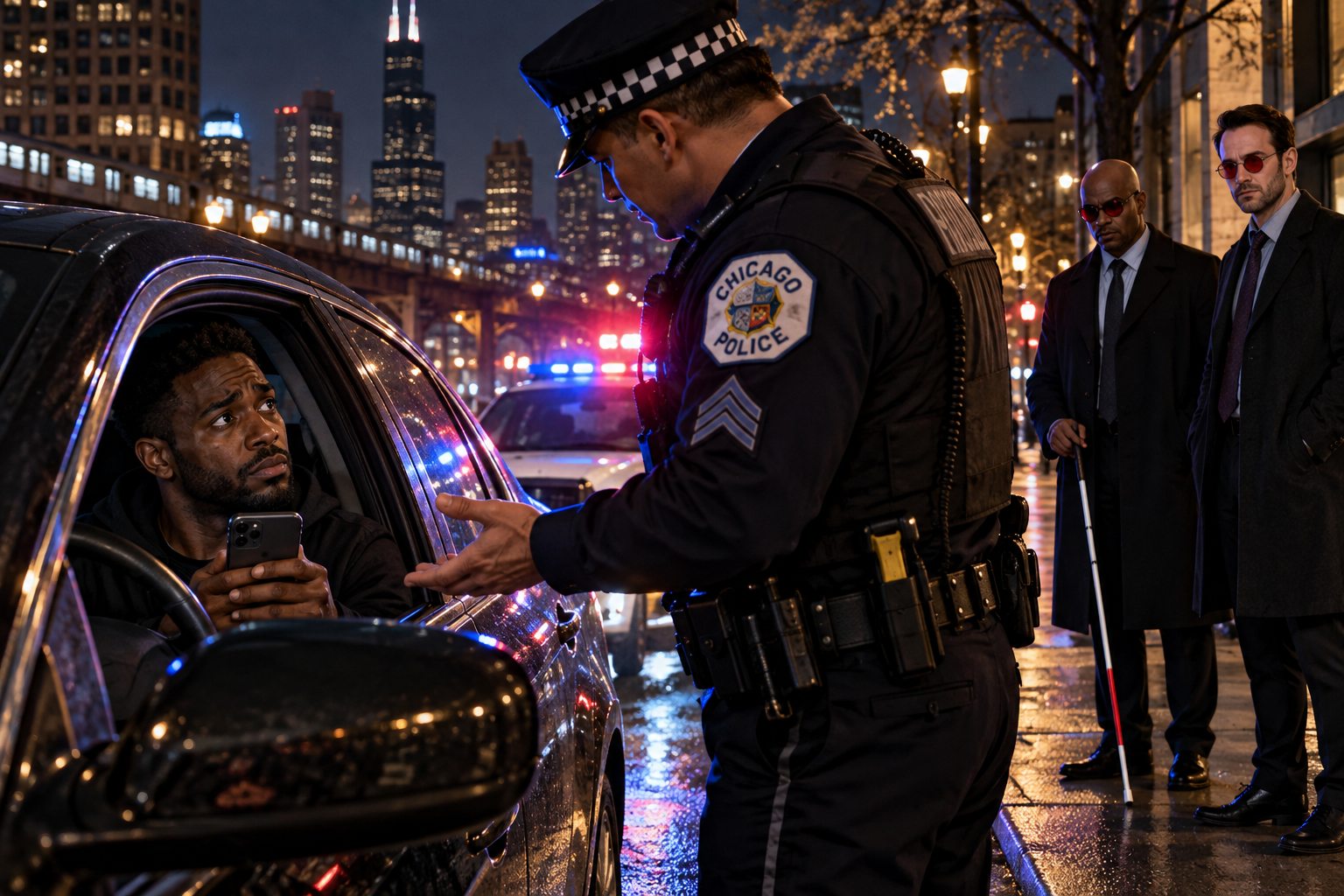
The Traffic Stop, the Smartphone, and the Constitution
From the Chicago desk of Murdock Esq.
The vibration reaches me before the sound does.
Tires cross the rumble strip, and the change travels through the floorboard and into the soles of my shoes. The engine drops several hundred revolutions. A moment later comes the unmistakable electronic pulse of a police siren behind us.
I cannot see the flashing lights.
I do not need to.
The driver beside me exhales differently. His right foot comes off the accelerator. Traffic rushes past our left side as the car moves toward the shoulder. The pavement changes beneath us, and the tires begin throwing small pieces of grit against the wheel wells.
Chicago traffic has its own vocabulary. The Kennedy does not sound like Lake Shore Drive. Lower Wacker has an acoustic signature nobody needs eyesight to recognize. An intersection on the South Side at midnight breathes differently from Michigan Avenue at five in the afternoon.
And a police stop has a sound all its own.
The patrol car settles behind us.
A door opens.
Boots strike pavement.
Then comes the waiting.
Anyone who has spent enough time practicing law knows that seemingly ordinary moments have a nasty habit of becoming constitutional law.
The officer reaches the driver's window.
License.
Registration.
Proof of insurance.
Fine.
Then comes a different request.
"Let me see your phone."
That sentence changes the encounter.
Because your driver's license identifies you.
Your registration identifies the vehicle.
Your insurance establishes coverage.
Your smartphone may contain your life.
Those are not remotely the same thing.
A Traffic Stop Is Not a General Search Warrant
Start with the ordinary stop.
Suppose an officer believes a driver was texting behind the wheel.
State traffic laws differ, but that distinction does not materially change the federal constitutional question addressed here.
The officer may have lawful grounds to stop the vehicle and investigate the suspected traffic violation.
That does not automatically give the officer authority to search the driver's phone.
A traffic stop is a seizure under the Fourth Amendment. Its permissible scope and duration remain tied to the traffic mission and to other constitutionally justified investigative activity.
In Rodriguez v. United States, 575 U.S. 348 (2015), the Supreme Court considered what happens when police extend a completed traffic investigation to pursue something else. Rodriguez was stopped after an officer observed his vehicle briefly travel onto the highway shoulder. After completing the ordinary traffic-related tasks, the officer detained Rodriguez further so that a police dog could conduct a sniff around the vehicle.
The Supreme Court rejected the idea that police receive a small amount of constitutionally free time simply because the detention began as a legitimate traffic stop.
The authority for the seizure lasts only as long as reasonably necessary to accomplish the traffic mission, absent additional legal justification for extending it.
That principle matters when the alleged traffic offense involves a cellphone.
An officer may say:
"I saw you texting."
That observation may support the traffic investigation.
What does not automatically follow is:
"Therefore, unlock your phone and let me read it."
The first concerns conduct the officer claims to have observed.
The second concerns access to stored digital information.
The Constitution recognizes the difference.
"Hand Me Your Phone"
I hear those words differently than some people probably do.
"Hand me your phone."
My fingers instinctively find the handle of my cane.
For a blind person, a smartphone is not merely a telephone.
It speaks.
It reads.
It navigates.
It identifies objects.
It translates visual information into information I can use.
Depending on how a blind person has configured it, the device may function as a map, document reader, currency identifier, communications terminal, camera assistant, authentication device, notebook, calendar, recorder, and connection to emergency assistance.
It may also contain messages, photographs, financial records, medical searches, family conversations, location histories, cloud storage, and communications with counsel.
Take the phone from the wrong blind person and you have not merely taken his telephone.
You may have temporarily taken part of his sensory infrastructure.
The Supreme Court understood the larger privacy issue in Riley v. California, 573 U.S. 373 (2014).
And Riley changed the constitutional treatment of the cellphone.
Riley v. California, When a Pocket Became an Archive
David Leon Riley was stopped by police for a traffic violation.
The encounter ultimately resulted in his arrest, and officers seized a cellphone from his person.
Police then examined the digital contents of that phone without first obtaining a search warrant.
The search uncovered photographs, videos, and other information that prosecutors later used in connection with much more serious criminal allegations.
The government relied upon the traditional doctrine permitting searches incident to lawful arrest.
Historically, that doctrine has substantial practical justification.
In Chimel v. California, 395 U.S. 752 (1969), the Supreme Court explained that officers making an arrest may search the arrested person and the area within his immediate control to protect themselves from weapons and prevent the destruction of evidence.
The rule was built around physical reality.
A pocket can conceal a knife.
A waistband can conceal a pistol.
A container within grabbing distance may hold destructible physical evidence.
Then the smartphone arrived.
Digital photographs cannot stab an officer.
Text messages cannot fire a weapon.
An email stored inside a phone cannot physically attack the arresting officer.
And the amount of private information stored on a modern smartphone bears little resemblance to what a person historically could carry in a pocket.
The Supreme Court therefore held unanimously in Riley that police generally must obtain a warrant before searching the digital contents of a cellphone seized incident to arrest.
Chief Justice Roberts captured the magnitude of the change. Modern cellphones are not simply another technological convenience. Their enormous storage capacity allows them to hold, in practical terms, the accumulated details of a person's private life.
The distinction is critical.
Police authority to possess a phone does not necessarily create authority to search what is stored inside it.
That is the starting point for any serious discussion of phones and traffic stops.
The Constitution Has Seen This Before
The technology is new.
The government's temptation is ancient.
In Entick v. Carrington, 19 Howell's State Trials 1029 (C.P. 1765), agents of the British Crown entered the home of political writer John Entick under authority of a general warrant.
They searched through his private papers looking for evidence of seditious publications.
Lord Camden rejected the government's claim of broad authority.
Entick became one of the intellectual foundations underlying the Fourth Amendment.
The principle survived because it addressed something larger than paper.
Government should not possess unlimited authority to rummage through private life hoping to discover evidence of wrongdoing.
Two and a half centuries later, the papers became digital.
The temptation remained exactly the same.
Only the storage capacity improved.
A Phone Is Not a Glove Compartment
Automobiles occupy an unusual position under Fourth Amendment law.
They travel public roads.
They are mobile.
They are extensively regulated.
Under the automobile exception recognized in cases such as Carroll v. United States, 267 U.S. 132 (1925), police with probable cause may in appropriate circumstances conduct warrantless searches of vehicles and containers where the object of the search might reasonably be located.
But putting a cellphone inside a vehicle does not transform its digital contents into the constitutional equivalent of the glove compartment.
That distinction follows directly from Riley.
Imagine what a thorough search of my phone might disclose.
Where I traveled.
Who called me.
Who I called.
What my screen reader opened.
What documents I dictated.
What appointments I attended.
What financial accounts I accessed.
What questions I researched.
What recordings I made.
What correspondence I exchanged.
Where I spent money.
Where I became lost.
Where I found my way home.
Search deeply enough and the government is no longer examining an object.
It is reconstructing a person from data.
That is qualitatively different from opening a console looking for contraband.
"But I Saw You Texting"
Now we reach the difficult part.
Suppose the officer says:
"I watched you using the phone while driving. Give it to me."
The officer's observations may provide evidence supporting the traffic offense.
They may also, depending upon the facts and applicable law, justify certain investigative actions.
But we need to keep two constitutional concepts separate.
Seizure and search are not synonymous.
A seizure interferes with a person's possession of property.
A search intrudes upon a protected privacy interest.
Under appropriate circumstances, police may potentially have lawful grounds to temporarily seize or preserve a device while still requiring a warrant before examining its digital contents.
That is why saying, "Police can never take your phone without a warrant," goes too far.
The stronger statement is narrower and considerably harder to knock down:
Police generally may not search the digital contents of a cellphone merely because they possess the device, stopped its owner for a traffic offense, or arrested its owner. A warrant, valid consent, or an established exception to the warrant requirement ordinarily must justify the digital search.
That is the distinction motorists need to understand.
Exigent Circumstances Are an Exception, Not an Incantation
Riley did not make digital information untouchable.
The Supreme Court expressly recognized that genuine exigent circumstances may permit warrantless action.
Imagine officers reasonably believe a phone contains immediately necessary information about the location of a kidnapped child.
Imagine an ongoing terrorist attack.
Imagine particularized facts establishing an immediate threat to human life.
Traditional Fourth Amendment doctrine recognizes that the government sometimes cannot wait for the ordinary warrant process.
But exigency is based on circumstances.
It is not created by saying the word "exigent."
And the theoretical possibility that digital information can be deleted cannot automatically justify searching every phone immediately.
If that were enough, the warrant requirement announced in Riley would collapse under its own exception.
Police can also take reasonable steps to preserve a phone while seeking judicial authorization.
The Supreme Court specifically discussed technological concerns about remote wiping and encryption in Riley rather than treating those possibilities as automatic permission to search.
Convenience is not exigency.
Curiosity is not exigency.
And generalized concern about evidence is not necessarily an emergency.
Consent, the Warrant You Can Give Away Yourself
There is another major exception to the warrant requirement.
Consent.
An officer is generally free to ask:
"Can I look at your phone?"
That question does not itself violate the Fourth Amendment.
And that is precisely why the answer matters.
Valid voluntary consent can eliminate the need for the government to obtain a warrant.
The motorist does not need to begin lecturing the officer about constitutional doctrine.
One sentence will do:
"Officer, I do not consent to a search of my phone."
Then stop.
Do not explain what is on it.
Do not explain why you object.
Do not start debating Riley through an open car window.
Do not ask the officer whether he remembers constitutional law from the academy.
There is a time and place for cross-examination.
The shoulder of the Dan Ryan at night is a particularly poor choice for both.
State the boundary.
Preserve the objection.
Remain physically compliant.
If the search happens anyway, lawyers and courts can deal with the legality afterward.
Refusing Consent Is Exercising the Right
The constitutional right to refuse a voluntary search would mean very little if exercising that right automatically supplied probable cause to conduct the search.
A motorist's refusal to consent, standing alone, does not transform a voluntary request into lawful search authority.
But this is where common sense needs to accompany constitutional principle.
Do not physically resist an officer who takes the phone.
Say:
"I do not consent to the seizure or search of my device."
Keep your hands where the officer can see them.
Remember what is said.
Do not escalate the physical encounter.
There is nothing heroic about turning a suppression issue into an obstruction charge, an injury, or a funeral.
The Constitution can be asserted verbally.
It does not need to be asserted with a tug-of-war.
The Fifth Amendment Problem Begins at the Lock Screen
Now suppose police possess the phone but cannot open it.
"Give me the passcode."
That raises a different constitutional question.
The Fourth Amendment governs the government's search.
The Fifth Amendment may govern whether the government can compel you to help perform it.
The Fifth Amendment protects against compelled testimonial self-incrimination.
The Supreme Court has long distinguished between physical characteristics and testimonial communications.
A person may, under appropriate legal authority, be required to provide fingerprints, appear in a lineup, provide a voice exemplar, or supply other physical evidence.
A memorized passcode is different.
The passcode exists in the suspect's mind.
Forcing the person to disclose it can communicate knowledge.
That is why compelled password disclosure has generated substantial litigation involving the Fifth Amendment's act-of-production doctrine and the "foregone conclusion" exception.
The law is not uniform nationwide.
Courts have disagreed over when compelled decryption or passcode production becomes testimonial and when the government already knows enough about the device and its contents to invoke the foregone-conclusion doctrine.
Therefore, the roadside advice should be conservative.
Do not volunteer passwords, PINs, cloud credentials, or encryption keys merely because an officer asks.
You can say:
"I do not consent to unlocking the device, and I want legal counsel before answering questions about access credentials."
Then stop talking.
Your Face and Finger Create a Harder Question
Biometric unlocking complicates matters.
A passcode is knowledge.
A fingerprint is ordinarily treated as a physical characteristic.
But using a fingerprint or face to decrypt a digital archive creates a hybrid problem.
The physical characteristic is being used to produce access to information.
Courts have divided over whether that act communicates something testimonial, such as possession, control, authentication, or knowledge of the device.
There is no single nationwide Supreme Court rule holding that every compelled biometric unlock is either constitutional or unconstitutional under the Fifth Amendment.
That uncertainty matters.
It means a motorist should not assume that Face ID, fingerprint unlocking, and a memorized passcode receive identical constitutional treatment.
They may not.
The safest general legal proposition is therefore not "biometrics are protected" or "biometrics are unprotected."
It is this:
Compelled biometric unlocking remains an evolving Fifth Amendment issue, and the answer can depend upon jurisdiction, the particular facts, the warrant or order involved, and what the compelled act itself communicates.
That is less satisfying than a slogan.
It is also what unsettled law looks like.
The Blind Man's Phone
I reach across my desk and find my phone by touch.
Glass.
Metal.
A small button.
Nothing about the object tells you what it means to me.
Then the accessibility software begins speaking.
The object changes.
For many sighted people, a smartphone augments perception.
For a blind person, it can mediate perception.
Navigation software can establish location and direction.
Optical recognition can read printed text.
Computer vision can identify objects.
Accessibility software can convert visual interfaces into speech or Braille.
The camera can become a reader.
The microphone can become a notebook.
The GPS can become orientation.
The phone can tell me which train platform I am approaching, whether I walked past the correct address, what a printed notice says, which medication bottle I am holding, and whether the document somebody slid across a counter is the document they claim it is.
That makes the privacy question unusually tangible.
Take the phone and search it because you suspect I touched the screen while driving, and you are not merely inspecting the alleged instrumentality of a traffic offense.
You may be opening the machinery through which I navigate private life.
That does not give blind people greater Fourth Amendment rights.
It demonstrates why everybody's rights matter.
Technology has become intimate enough that searching the machine can resemble searching the mind that uses it.
The Sociological Shift
The Framers never held a smartphone.
They would have recognized the political problem immediately.
A colonial desk could contain private correspondence.
A smartphone can contain years of it.
A desk might contain a financial ledger.
A smartphone may expose nearly every financial transaction.
A diary records what its author consciously chooses to preserve.
A smartphone may continuously generate location records without its owner writing a word.
A family album contains selected photographs.
A phone may contain thousands of photographs, timestamps, locations, faces, videos, deleted material, cloud connections, and metadata.
This accumulation matters.
That was one of Riley's central insights.
Technological change becomes constitutionally significant when differences in quantity become differences in kind.
Searching a phone is not equivalent to opening a wallet.
It can expose a historical portrait.
The Exclusionary Rule
Suppose police search anyway.
Then we reach Mapp v. Ohio, 367 U.S. 643 (1961).
Police forcibly entered Dollree Mapp's Cleveland home while seeking a bombing suspect and evidence allegedly connected with illegal materials.
The Supreme Court held that the exclusionary rule applies to the states through the Fourteenth Amendment.
Evidence obtained in violation of the Fourth Amendment generally cannot simply be used by the prosecution as though the unconstitutional search never occurred.
The doctrine has accumulated exceptions.
Good faith.
Independent source.
Inevitable discovery.
Attenuation.
Any lawyer who tells you suppression is automatic is saving you the inconvenient experience of reading several decades of Supreme Court opinions.
But the basic principle remains important.
The government ordinarily should not benefit in a criminal prosecution from evidence acquired through an unconstitutional search.
Phones make that problem particularly serious because digital evidence reproduces investigative leads.
One message identifies another person.
That person identifies a location.
The location produces surveillance footage.
The footage identifies another suspect.
The suspect produces another device.
One unconstitutional search can grow branches.
That is why the constitutional fight belongs at the root.
The Chicago Stop
The officer reaches the window.
Behind him, another car passes fast enough that its wake pushes against ours.
The police radio on his shoulder spits out fragments of another call.
Somewhere farther down the expressway, a horn stays depressed for several seconds.
Chicago reminding everybody that patience remains theoretical.
The officer asks:
"Were you using your phone?"
Then:
"Let me see it."
That is the moment.
Not because every officer asking the question is acting unlawfully.
Not because motorists should treat police as constitutional adversaries.
Not because every traffic stop conceals a criminal investigation.
Because government power works best when both sides understand its limits.
The officer has lawful authority.
The motorist has constitutional rights.
Those propositions can occupy the same roadside.
So the answer is simple.
"Officer, I do not consent to a search of my phone."
No speech.
No argument.
No physical resistance.
Just the boundary.
The Digital Cane
Back in my office, my cane rests beside the desk.
The phone lies a few inches away.
Both help me navigate.
Only one remembers where I have been.
That difference tells you almost everything you need to know about digital privacy.
Search my cane and you will learn very little.
Search my phone deeply enough and the government may reconstruct portions of my life I no longer remember myself.
The Fourth Amendment was written before automobiles.
Before telephones.
Before computers.
Before GPS.
Its durability comes from the fact that it protects principles rather than machinery.
The people have a right to be secure against unreasonable searches and seizures.
Today our papers speak.
Our effects remember.
Our correspondence travels invisibly.
Our photographs know where they were taken.
Our devices may remember where we slept.
The constitutional principle does not disappear because the container changed.
If anything, the warrant requirement becomes more important.
A warrant requires government to stop.
Articulate facts.
Establish probable cause before a neutral magistrate.
Identify with particularity the place to be searched and the things to be seized.
That pause is not a technical inconvenience.
It is part of the architecture.
My cane works through a similar principle.
It forces me to test the ground before committing my full weight.
Probable cause tests the ground.
Particularity tests the ground.
Judicial review tests the ground.
The warrant requirement tests the ground.
So when the government believes my phone contains evidence of a crime, there is a constitutional procedure available.
State the facts.
Establish probable cause.
Obtain a warrant that satisfies the Fourth Amendment.
Then conduct the search the warrant actually authorizes.
Until then, one sentence is enough.
I do not consent to a search of my phone.
Chicago can keep making all the noise it wants outside.
Some boundaries should remain perfectly clear.
From the Chicago desk of Murdock Esq